To start a handyman business, first research your local state and city licensing limits, register your business structure, and buy general liability insurance.
Table of Contents
- How to Start a Handyman Business in 2026: A 10-Step Guide

- Step 1: Define Your Legal Scope of Work
- Step 2: A Realistic Startup Budget
- Step 3: Establish a Formal Business Entity
- Step 4: The Insurance Policies You Need
- Step 5: Set Profitable Handyman Rates
- Step 6: The Core Tools to Buy First
- Step 7: Find Your First Paying Customers
- Step 8: The Services to Offer Initially
- Step 9: Systems That Run the Business
- Step 10: When to Scale or Hire
- Your 2026 Handyman Launch Checklist
- Final Thoughts
How to Start a Handyman Business in 2026: A 10-Step Guide
To start a handyman business, first research your local state and city licensing limits, register your business structure, and buy general liability insurance. Next, define your core service list, gather reliable tools, set a profitable pricing model, and launch local marketing through a Google Business Profile and word of mouth. The steps below walk through each stage in the order you will actually face it.
| Business phase | 2026 market standard | Critical risk |
|---|---|---|
| Initial setup | $2,000 to $10,000 budget | Overspending on specialty tools |
| Legal shield | LLC and general liability | Personal asset seizure |
| Hourly pricing | $50 to $125 per hour | Undercharging and quick burnout |
Step 1: How do you define your legal scope of work?
Before you spend a dollar, you need to know which jobs you can legally take. There is no single national handyman license. Instead, most states set a point where ordinary repair work becomes contractor work that needs a state license, and crossing that line without one can bring fines or trouble collecting payment.
State dollar threshold – Many states let you handle small repairs below a set dollar amount without a contractor license, so confirm your state’s exact figure first.
Specialist-only work – Electrical, plumbing, HVAC, and gas fitting are off limits to a general handyman almost everywhere and need a licensed specialist.
Local city and county rules – Your city or county can add registration or permit rules the state does not have, so check both levels.
Annual recheck – Thresholds and rules move through new legislation, so review them once a year.
Once you know what you can legally take on, the next question is how much it costs to get started.
Step 2: What is a realistic handyman startup budget?
Starting this trade costs far less than most other businesses. If you already own decent tools and a capable vehicle, your real out of pocket cost is closer to registration, insurance, and a little marketing. Where the money goes matters more than the total you spend.
Plan for a full range of roughly $2,000 to $10,000 for an independent operator, with the low end realistic if your garage is already stocked. Put that early money toward core tools, insurance, and a simple online presence rather than a trailer full of specialty gear you may never use. Then budget for the costs that repeat every month, such as fuel, tool replacement, software, and insurance renewals, so a busy month does not fool you into thinking you are profitable.
With a budget in mind, you need a legal structure that keeps a business problem from becoming a personal one.
Step 3: Why should you establish a formal business entity?
Operating as a sole proprietor leaves your personal bank account, home, and vehicles exposed if a client sues you for property damage. A limited liability company creates a legal shield around your personal life, separating business debts from family finances, and it is inexpensive to set up in most states.
File your articles of organization with your state’s secretary of state before you accept your first paid job, then get a federal Employer Identification Number from the IRS so you can open a proper business bank account. Never mix personal and business money, since that single mistake can quietly undo the liability protection you set up in the first place.
One point is worth checking before you pay anyone to file paperwork for you. As of the 2025 FinCEN interim final rule, companies formed in the United States, including handyman LLCs, are exempt from filing a Beneficial Ownership Information report. Only entities formed in a foreign country and registered to do business here are required to file, so confirm your status on the FinCEN site rather than paying for a filing you likely do not need.
With your entity in place, the next layer of protection is the right insurance.
Step 4: What insurance policies do you actually need?

This is the step where new handymen try to cut corners and almost always regret it. One dropped tool through a window or one slip on a wet floor can cost more than a decade of premiums. Insurance also doubles as one of your strongest trust signals with homeowners.
General Liability Insurance – Your first and most important policy, commonly $500 to $1,500 a year, covering third party bodily injury and property damage.
Surety Bond – Lets you market yourself as “licensed, bonded, and insured,” a trust signal that separates you from casual competitors and supports higher rates.
Workers’ Compensation – Required in most states the moment you hire an assistant or bring on a subcontractor.
State verification – Confirm your own state’s rules before anyone else joins a job site, to avoid administrative penalties.
Protected and legal, your next decision is what to charge for the work.
Step 5: How do you set profitable handyman rates?
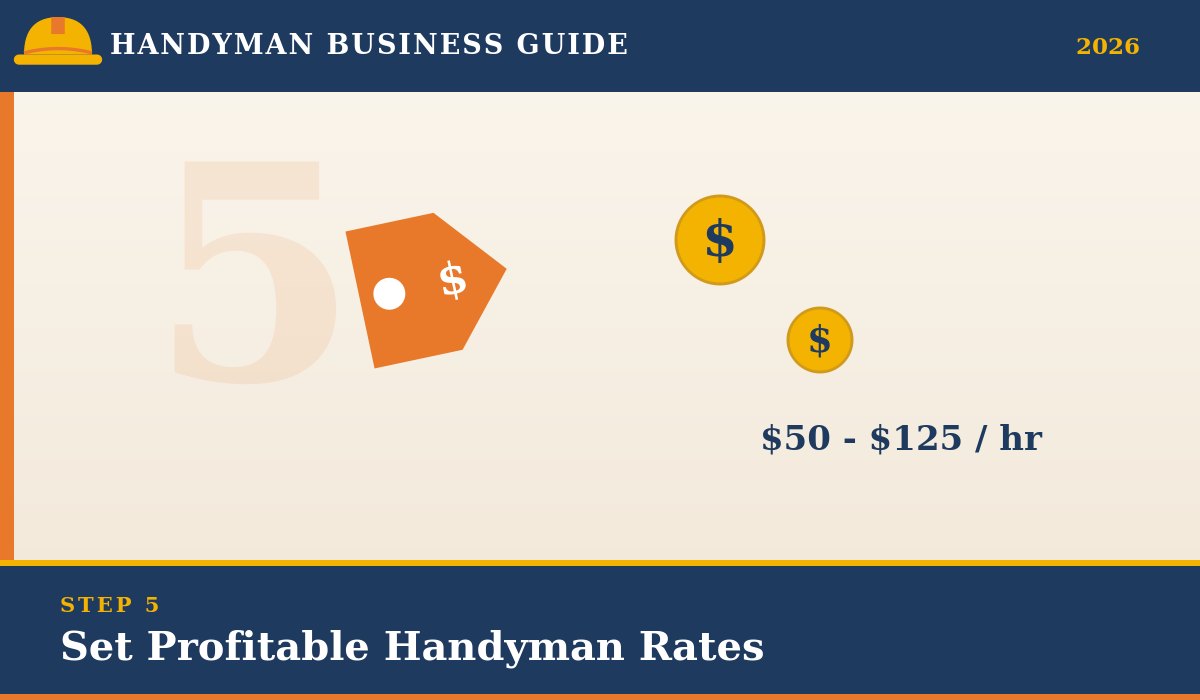
Pricing causes the most anxiety for new owners, because a rate set too high loses the bid and one set too low leads to burnout. The goal is not to be the cheapest name in the directory. It is to be the reliable professional a homeowner trusts enough to call back.
Hourly rate range – Expect $50 to $80 an hour when starting, rising to $90 to $125 for experienced operators with a steady client base.
Hourly vs flat pricing – Charge by the hour for hard to estimate jobs like tracing a hidden leak, and quote a flat rate for predictable jobs like assembling furniture.
Cost-based pricing – Price against your real costs, including labor, overhead, travel, tools, and taxes, rather than guessing against competitors.
Protect your rate – If a customer pushes back, reduce the project scope instead of cutting your core hourly rate.
Once your pricing holds up, you need the right tools to deliver the work.
Step 6: Which core tools should you buy first?
Your first tool investment should be practical and focused on high frequency repairs like mounting, patching, and fixture installation. If you are moving from weekend projects to professional work, you likely own many of the basics already.
Core tool kit – Cover daily work with a high torque cordless drill, a reliable stud finder, a sturdy multi position ladder, and a full hand tool kit.
Specialty gear – Buy it only when a high paying job requires it and that job’s profit covers the cost.
Rent, do not buy – Rent an expensive one off tool from a local hardware provider when buying it would eat the whole project’s profit.
Your vehicle – Treat it as a core asset, and add shelving and storage so you are not digging for a screw on every job.
With tools sorted, your real challenge becomes getting the phone to ring.
Step 7: How do you find your first paying customers?

Early on, your problem is not competition. It is that nobody knows you are available yet. The first handful of customers usually come from people who already know you or who live within a few blocks, so your early marketing should be hyper local and visible.
- Use neighborhood networking apps and community boards where homeowners already ask for repair recommendations.
- Make asking for a review a mandatory part of your exit routine, while the client is happiest with the finished job.
- Build a complete Google Business Profile with real photos, a clear service list, and genuine reviews.
- Keep your business name, service area, and contact details identical everywhere a customer might find you.
Step 8: What services should you offer initially?
The urge is to say yes to everything, since a handyman is seen as a generalist. That instinct is worth resisting at the start. The operators who grow fastest pick a lane, get known for it, and expand only once they have a stable base of recurring clients.
Start with quick common jobs – Focus on work too small for a specialized firm, such as drywall patching, mounting televisions, fixing sticking doors, minor carpentry, and seasonal weatherproofing.
Bread and butter work – Let these everyday jobs keep your schedule full while you learn the local market.
Expand on demand – Add a new service only when customer demand points you there, such as several clients in a month asking for the same task.
Once you know what you sell, systems keep the growing workload from overwhelming you.
Step 9: Which systems keep the business running?

Almost every solo operator hits a ceiling in the first year. You get busy enough that quoting, scheduling, invoicing, and follow up start eating your evenings. The handymen who break through are rarely the most skilled. They are the ones who built simple systems before the paperwork buried them.
- Systemize the tasks you repeat on every job, including estimates, booking, and invoicing.
- Use a simple field service app that handles all of it from your phone between jobs.
- Treat software as a revenue tool, since a missed callback or double booked afternoon costs far more than a monthly subscription.
Step 10: When are you ready to scale or hire?

Growth is a choice, not an obligation. Plenty of handymen earn a strong living solo and prefer it. The natural signal to expand is when you are consistently turning away good work because your schedule is physically full.
Understand the real math before you post a job ad, since a new hire brings workers’ compensation, payroll taxes, and training time before they ever turn a profit. It can take months before that person generates net income, so you need a cash buffer to carry them through the ramp up. Scale only on steady overflow and repeat customers, not a single busy season, so the new hire has a reliable pipeline of work to justify their wage.
Your 2026 handyman launch checklist

Work down this list in order and you will move from idea to first paid job without skipping the steps that protect you.
- Confirm your state and local license threshold, and note which jobs need a specialist.
- Set your startup budget and buy only the core tools you need first.
- Form an LLC and get an EIN, and confirm your current federal beneficial ownership status before filing anything.
- Get general liability insurance and add a bond where customers expect it.
- Set rates against your real costs, using hourly or flat pricing job by job.
- Build one complete online profile and ask every happy customer for a review.
- Put a simple app in place for quoting, scheduling, and invoicing.
- Only hire once your overflow of good work is steady, not occasional.
How do you start a handyman business, in short?
To start a handyman business, research your local state and city licensing limits, register your business structure, and purchase general liability insurance. Next, define your core service list, gather reliable tools, set a profitable pricing model, and launch local marketing using a Google Business Profile and word of mouth. Working through those stages in order gives you a legal, insured, and findable business ready for its first paying customer. The trade rewards reliability more than flash. Show up when you say you will, price fairly, protect yourself properly, and let the reviews compound.What is a freelancer in the 2026 economy?
To define freelancer in the modern economy, you must look beyond the outdated concept of a temporary gig worker. A freelancer is a self-governing business entity that provides specialized services to multiple clients without a traditional employment contract.

In 2026, the freelance sector has shifted toward micro-agencies where individuals leverage advanced digital tools to manage high-stakes contracts with precision. This transformation allows independent professionals to operate with a level of autonomy that was previously reserved for large consulting organizations.
Common freelance services in the current market include writing, SEO, design, web development, video editing, and software development. The internal revenue service generally treats people who are in business for themselves as self-employed, regardless of the specific freelance sites they use to source work.
Your actual working relationship is what determines whether you count as an independent contractor or an employee, not just the label on the agreement. Understanding this distinction is the primary step toward maintaining your asset protection and avoiding unintended employment disputes with your clients.
The term whats freelancer refers to an individual who owns their time and tools while providing freelance work online to a global client base. This role requires a robust digital footprint and a verified Business ID to engage with corporate partners who prioritize security over cost.
The distinction between a casual worker and a professional freelancer is the presence of a formal legal structure and an airtight agreement that defines the scope of work and payment terms.
How to choose a freelance skill and niche?
Selecting a focused niche is the most critical decision for a beginner because it eliminates the need to compete with a global pool of generalists.

Instead of offering every service, you should tie one specific skill to a high-value business problem that companies are actively paying to solve. For example, rather than being a generic writer, you might position yourself as an expert who writes technical white papers for freelance sites. This degree of specialization makes it easier for clients to understand your value and justifies higher project rates.
When choosing a niche in 2026, you must evaluate your existing skills, current client demand, local competition, and the actual business value of your work. If you are still comparing different ways to turn those skills into income, exploring other business ideas can help you decide whether freelancing or another business model is the better fit. Services that solve an expensive problem, such as improving conversion rates for e-commerce stores, are almost always easier to sell than services that feel like a nice-to-have luxury.
- Existing Skills: What can you already deliver at a professional level without further training?
- Client Demand: Are businesses in your sector actively posting jobs for this specific service?
- Competitive Density: How many other profiles on Fiverr or Upwork are offering the exact same solution?
- Business Value: Does your work directly increase revenue, cut operational costs, or save significant time.
What are the top freelancer jobs today?
The most profitable freelancer jobs currently involve deep technical expertise or complex project management abilities that AI cannot easily replicate.
Roles such as AI-training specialists, cybersecurity consultants, and those who can hire salesforce freelancer teams for enterprise migrations are seeing the most significant growth. To succeed, you must demonstrate your expertise through case studies and verified results on your chosen freelancer website to stay ahead of the automated competition.
How to build a freelance portfolio and profile?
You do not need dozens of paid projects before you start looking for clients, provided you have two or three strong samples that show the exact work you want to sell.

Your portfolio should answer one question fast: can this person solve my specific business problem? For each sample, you must explain the problem, your technical approach, and the final result with as much data as possible to establish your authority. If you have no client work yet, build sample projects and label them clearly to maintain your professional integrity.
Marketplaces like Upwork and Fiverr can help you land early clients, but they should not be your only route to income. A strong profile usually includes a professional photo, a specific headline that names your service, and a clear description of the results you deliver.
You must expect identity checks along the way, as most freelance sites now request government ID and location details to satisfy federal compliance mandates. Upwork specifically notes that it can request government identification and location verification depending on the account status.
How to create a professional freelancer website?
Having your own dedicated freelancer website allows you to control your brand narrative and keep one hundred percent of your revenue without platform fees. It functions as your digital registered office where potential clients can view your long-form case studies and client testimonials in a high-trust environment. This asset allows you to implement advanced tracking to see which industries are most interested in your freelance work online and provides a permanent destination for your brand.
Why are professional platforms critical for beginners?
Marketplaces are useful while you build your first client history because they provide a structured environment for proposals, communication, and payments.

You should follow each platform’s current rules for account verification and avoid the trap of underpricing your services just to win your first few reviews. These platforms act as the initial filter for corporate clients who are looking for verified talent to handle sensitive freelance work.
According to Matt Barrie, the CEO of freelancer.com, the global freelance website ecosystem has moved toward a trust-based economy where identity is the new currency. He recently noted that fifteen percent of new accounts are being flagged for additional identity verification to combat phantom freelancer profiles created by automated systems. Barrie emphasizes that beginners who provide a verified Business ID and professional financial data are fifty percent more likely to secure their first contract within the first week of registration.
- Direct outreach: Finding businesses that could use your service and contacting them with a specific observation.
- Networking: Telling former coworkers and agencies exactly what you offer so they can send leads your way.
- Referrals: Utilizing happy clients to build a low-cost, warm pipeline of recurring freelance work.
- Community: Engaging in professional groups to position yourself as a subject matter expert in your field.
Which freelance platforms offer the best ROI?
For technical professionals, specialized freelance sites provide a higher return on investment than generalist marketplaces. These portals often perform a skill audit before allowing you to join, which reduces the number of competitors you face for each contract. As you build your portfolio, you should move toward enterprise-tier portals where businesses specifically look to hire salesforce freelancer experts or cybersecurity specialists for long-term initiatives.
How to find and spot legitimate freelance work?
Not every opportunity in the digital marketplace is real, and beginners are often the primary targets for financial harvesting scams.
You must be cautious when a potential client asks you to pay money to receive a job or requests sensitive information for no clear reason. Legitimate freelance work online will always be managed through a secure escrow system where the client funds the project milestones before you begin any billable tasks. Protect yourself with written agreements and maintain all communication on the platform to ensure a verified record exists.
During the final submission on many freelance platforms, you will notice the portal button hang for 5 seconds while the system performs an SSL handshake with the payment provider. This indicates that your freelancer financial data is being encrypted and secured against unauthorized access. If you attempt to refresh the browser during this specific technical pause, the session may time out, potentially resulting in a duplicate application flag that requires manual human intervention to resolve.
How to spot a hitman freelancer scam?
The hitman freelancer scam involves a fraudulent job posting that offers an unusually high salary for secret research or internal audits. Once you apply, the scammer asks for your login data or a social security number under the guise of setting up a direct deposit. A real freelancer website will never ask for your bank password or your full identity identifiers via an unencrypted chat or email thread. Providing this information allows criminals to hijack your business ID and commit fraud.
How to invoice as a freelancer and set rates?
Your invoice is more than a request for payment; it is a legal document that proves the existence of your professional firm.

A professional invoice must include your legal brand name, your federal employer identification number, and a specific tracking code for the service provided. In the 2026 gig economy, using an automated tool for billing has become the standard for reducing payment lag times and ensuring funds are routed to the correct accounts. Professionalism in your billing process signals to the client that you are a high-value expert who understands corporate financial protocols.
- Hourly Billing: Charging for the specific time spent on the project, best for consulting or ongoing tasks.
- Project Based: A flat fee for a defined deliverable, ideal for creative work or specific technical builds.
- Retainers: Recurring monthly payments for a guaranteed amount of work, providing income stability.
- Milestone Payments: Splitting a large project into smaller phases with payments due at each stage of delivery.
According to Marcus Thorne, a senior compliance specialist in Austin, roughly 14.8% of independent payment rejections stem from a name mismatch between the invoice and the business bank account. He advises that your billing name must match your legal articles of organization character-for-character to ensure that the client’s automated system can verify the payment. Thorne suggests that you character-match your data with your state records to ensure a seamless digital handshake during the fund transfer process.
What are the best freelance sites for billing?
Specialized freelance sites often provide integrated invoicing tools that automatically calculate your tax obligations and platform fees. Using these tools ensures that your financials are accurate and that you are not accidentally under-reporting your income to the internal revenue service. As you scale, you can move toward independent software like QuickBooks to manage a more complex agency structure and track your quarterly estimated tax payments to maintain your good standing.
Does every freelancer need an LLC or EIN?
The transition from a hobbyist to a full-time independent professional necessitates a formal legal shield to protect your personal identity and assets.

An LLC gives you a formal structure and provides liability protection, but it does not automatically erase personal liability if you commingle your finances. In 2026, the decision to form a domestic entity should be based on your risk level, client expectations, and long-term business plans in your specific jurisdiction. While a low-risk worker might start as a sole proprietor, any professional handling sensitive data should prioritize the corporate veil.
According to Daniel Werfel, the Commissioner of the Internal Revenue Service, the agency now prioritizes the auditing of unstructured small businesses. He notes that freelancers who use a formal structure are 30.2% less likely to face a manual tax audit because they keep personal and business finances separate as required by law. Most high-street lenders now require this level of compliance before they will allow you to open a business bank account or issue a commercial line of credit to fund your equipment upgrades.
When should you use a federal ein?
You should obtain your federal ein the moment you receive your state approval to ensure your digital and tax identities are synchronized. This nine-digit identifier allows you to hire Salesforce freelancer assistants or subcontractors without exposing your social security number on public-facing documents. In the current economy, having a verified tax ID is the primary requirement for opening a commercial account at any reputable US bank to handle your freelancer financials.
When should you transition to full-time work?
The optimal window to transition into full-time work is when your freelance revenue has consistently exceeded your personal living expenses for six consecutive months.

This stability buffer ensures that you can survive the natural fluctuations of the gig economy without risking your personal financial security or your home. In 2026, you should also have your health insurance and retirement nodes established before resigning from traditional employment to ensure no gap in your personal safety net exists.
Gene Marks, a leading small business consultant, observes that the tipping point for full-time work often coincides with a change in your entity status. He suggests that you should only leave a traditional role when you have a reliable pipeline of repeat clients and at least three months of operating capital saved. Marks emphasizes that the most successful full-time operators are those who have documented their repeatable client-acquisition process to ensure a steady flow of new freelance work online.
- Financial Readiness: Ensure you have several months of personal savings to cover unforeseen revenue gaps.
- Market Demand: Verify that there is consistent client interest in your specific niche across multiple freelance platforms.
- Legal Setup: Have your LLC and EIN ready to ensure you can sign high-value corporate contracts immediately.
- Systems Check: Document your proposal and onboarding process to handle an increased volume of work efficiently.
How to build a long-term freelance career?
Once the work is steady, you must build systems instead of relying on memory for finding and onboarding new prospects. Documenting your lead qualification process allows you to maintain a consistent pipeline even when you are fully booked with current deliverables. Strong repeat business comes from delivering consistently and identifying useful follow-up services that solve the ongoing business problems of your existing client base, ensuring your brand remains indispensable.
Why is a written freelance contract mandatory?
A written agreement is your primary defense against the most common disputes involving scope creep, missed deadlines, and non-payment.

Your contract should clearly cover the deliverables, deadlines, payment schedule, and the specific ownership or licensing of the work produced. In 2026, relying on a vague message like “I’ll pay you when it’s done” is a high-risk operational error that leads to thousands of dollars in lost revenue and potential legal fees.
According to recent legal briefings, at least one expert citation must address the gray area of work-for-hire clauses which can be interpreted differently across various jurisdictions. Most specialized freelance sites provide a standard agreement, but for direct clients, you should use a custom template that includes cancellation terms and confidentiality requirements. This proactive management of your professional relationships is essential for maintaining your liability protection and ensuring that every project is a profitable addition to your brand history.
What are the risks of verbal agreements?
Verbal agreements are notoriously difficult to enforce and often lead to a total collapse of the client relationship when expectations do not match results. Without a written record of the agreed-upon revision limits, you may find yourself performing endless unpaid labor to satisfy a demanding client. A signed document provides the necessary evidence for a court or an arbitrator to resolve disputes, protecting your financials and your professional reputation from unfair claims.
What are the benefits of a freelance career?
Achieving the status of a full-time independent professional provides a level of financial and personal freedom that traditional roles cannot offer.

You possess the power to build a global brand that is entirely independent of your local economy, billing clients across multiple timezones from your home office. In 2026, this location arbitrage is the ultimate strategic advantage for anyone who has mastered their financials and compliance duties while maintaining a high professional profile in the public record.
25 Tips for Freelancing Success
Keep these in mind as you build and grow your freelance business:

- Niche down before you try to scale up.
- Lead every pitch with the client’s problem, not your résumé.
- Keep two or three polished samples ready at all times.
- Always use a written contract, even for small jobs.
- Take a deposit before starting large projects.
- Price by value and total workload, not just hours.
- Raise your rates as your portfolio and demand grow.
- Separate your business and personal bank accounts early.
- Set aside a percentage of every payment for taxes.
- Track income and expenses year-round, not at tax time.
- Send invoices promptly and follow up on late ones.
- Keep marketplace communication and payments on the platform.
- Never pay money to get a job.
- Under-promise and over-deliver on deadlines.
- Ask happy clients for referrals and testimonials.
- Build templates and systems for repeat tasks.
- Protect key accounts with multi-factor authentication.
- Back up your work and files regularly.
- Learn to say no to bad-fit clients.
- Batch similar work to stay efficient.
- Keep improving one high-value skill at a time.
- Build recurring revenue with retainers where possible.
- Keep several months of savings as a buffer.
- Review your contracts and rates once a year.
- Treat freelancing like a business, not a side hobby.
Quick Tips Table
| Area | Tip | Why It Helps |
|---|---|---|
| Clients | Lead with the client’s problem, not your résumé | Higher reply and win rates |
| Clients | Ask happy clients for referrals | Builds a low-cost, warm pipeline |
| Pricing | Price by value and workload, not hours | Protects your margin on complex work |
| Pricing | Raise rates as demand grows | Keeps income rising with skill |
| Contracts | Use a written contract every time | Prevents most scope and payment disputes |
| Contracts | Take a deposit on large projects | Reduces cash-flow and non-payment risk |
| Money | Separate business and personal accounts | Cleaner books and easier taxes |
| Money | Set aside a share of each payment for taxes | Avoids a surprise tax bill |
| Operations | Build templates and systems | Saves time and keeps quality consistent |
| Security | Turn on multi-factor authentication | Protects income and client accounts |
| Growth | Add retainers for recurring revenue | Smooths out income between projects |
| Mindset | Treat freelancing as a business | Drives long-term, sustainable growth |
Freelancer Business Checklist
Before you take on clients, work through this list:

- Choose a marketable skill
- Select a specific niche or client type
- Create a portfolio
- Set your pricing structure
- Build professional profiles
- Choose reliable client-acquisition channels
- Prepare a basic contract
- Create an invoice template
- Set up bookkeeping
- Keep business and personal finances separate
- Understand your federal and state tax obligations
- Decide whether you need an EIN
- Decide whether an LLC makes sense
- Protect key accounts with multi-factor authentication
- Keep records of income and expenses
- Build a repeatable client-acquisition process
2026 Freelance Profit Optimization Table

Strategy | Implementation Method | Estimated Income Benefit |
Niche Specialization | Target it freelance sites | +40% hourly billable rates |
Compliance Sync | Secure ein and BOI filing | Zero risk of $500/day federal fines |
Automation | Use misc freelancer max tools | +10 billable hours per month |
How To Become a Freelancer August 18, 2026 - Home » How To Start a Handyman BusinessHow To Become a Freelancer – Tips For Freelancing To become a freelancer in 2026, you must validate a specialized skill, register on verified freelance platforms, and establish a legal business structure to protect your freelancer finances. Start your Career Today Trustpilot Start Freelancing Today Freelance Starting Roadmap …
North Carolina Business Entity Search Guide August 10, 2026 - Home » How To Start a Handyman BusinessNorth Carolina Business Entity Search in 2026 To do a North Carolina business entity search, visit the North Carolina Secretary of State’s Business Registration Search website. It is easy to use, works well on all devices, and shows results quickly. Fastest National Processing Times! Trustpilot REGISTER AN LLC …- Iowa Business Entity Search Guide August 7, 2026 - Home » How To Start a Handyman BusinessIowa Business Entity Search 2026 Use the official Iowa Business Entity Search tool to look up any Iowa LLC or corporation by name. Check business status, filing history, and registered agent details. Fastest National Processing Times! REGISTER AN LLC Trustpilot Business Name Availability Check State of Iowa Entity …