Benefits of an LLC in Virginia - Tax benefits & Easy Incorporating
In Virginia, an LLC offers several benefits, including personal liability protection, tax flexibility, and ease of incorporation.

A Virginia LLC offers personal liability protection, pass-through taxation, easy management, and business credibility. It also gives low startup costs, simple annual requirements, and tax flexibility with S-Corp election.
The Virginia Department of Taxation shows tax rates stay low, just 2–5.75%. You may also save up to 20% with the QBI deduction.
LLCs cut paperwork. They build trust with banks and clients. With S-Corp status, you reduce self-employment tax and keep pass-through perks. In this article, we cover more on benefits, costs, and how to form one.
What Is an LLC and How Does It Work in Virginia?
A Limited Liability Company (LLC) is a legal business structure that separates personal assets from business debts. It offers flexibility with fewer formalities than corporations. The IRS typically treats LLCs as pass-through entities, helping avoid double corporate tax.
In Virginia, forming an LLC is fast and simple. The Virginia SCC processes most filings online within days. A report from George Mason University confirms its popularity among small business owners and solo shareholder startups for its ease and legal protection.
This structure keeps personal assets safe while offering room to grow. The IRS allows added flexibility with S-Corp election options. For anyone launching a business in Virginia, an LLC is both protective and practical.
Top Benefits of Forming an LLC in Virginia
A Virginia LLC gives you liability protection, pass-through taxation, and easy management. Over 120,000 active LLCs thrive in 2024, per the Virginia State Corporation Commission (SCC). A Virginia Commonwealth University study shows LLCs save big on taxes. Here are seven benefits to boost your small business in Richmond, Virginia Beach, or anywhere in Virginia!
1. Personal Liability Protection
A Virginia LLC keeps your personal assets—home, car, savings—safe from business debts or lawsuits. This is backed by Virginia Code (§ 13.1-1000 et seq.).
Example: Ava in Richmond faced a $12,000 lawsuit. Her LLC saved her savings, so she kept running her bakery.
2. Saves Money
LLC profits go to your personal tax return, taxed at Virginia’s 2–5.75% rate (2025), per Virginia Department of Taxation. No corporate taxes. Get up to 20% off with the QBI deduction, per IRS.
Example: Ethan in Virginia Beach saved $3,500 with QBI and bought new gear.
3. Easy and Flexible Management
Choose single-member or multi-member LLCs. Pick member-managed or manager-managed, per Virginia SCC. An operating agreement simplifies decisions, per Virginia Code (§ 13.1-1023).
Example: Zoe in Alexandria went member-managed, saved 25% planning time, and signed $10,000 in client deals.
4. Boosts Business Credibility
An LLC makes your business look professional to clients, vendors, and banks. Open business bank accounts and win contracts, per Virginia Economic Development Partnership.
Example: Liam in Fairfax got a $15,000 supplier deal after forming his LLC.
5. Low Cost to Start
Form your LLC for just $100 (online Articles of Organization) via Virginia SCC eFile, per Virginia SCC. Virginia is small business-friendly.
Example: Mia in Roanoke paid $100 and opened a bank account fast.
6. Simple Annual Requirements
Pay a $50 annual registration fee, per Virginia SCC. No complex annual reports needed, unlike corporations, per Virginia Code (§ 13.1-1065).
Example: Noah in Chesapeake paid $50/year, saved $150 vs. corporate fees, and updated his website.
7. Tax Flexibility with S-Corp
Choose S-Corp status via IRS Form 2553 to cut self-employment tax (15.3% federal), per Virginia Department of Taxation. Keep pass-through benefits.
Example: Emma in Norfolk saved $2,800 with S-Corp and hired an assistant.
A Virginia LLC offers protection, savings, and simplicity. File your Articles of Organization for $100 at Virginia SCC eFile. Grow your small business today!
Tax Benefits of an LLC in Virginia
Virginia keeps taxes simple for LLCs. You skip the corporate layer and pay only once on your personal return. That’s a win for small business owners, freelancers, and founders looking to keep more of what they earn.
The state also offers targeted credits and pro-growth policies that make LLCs the go-to choice.
Pass-Through Taxation
LLC income passes directly to your personal tax return, avoiding double taxation. You pay Virginia’s individual income tax (between 2%–5.75%, 2025 rates), and not a corporate tax.
The IRS still treats your LLC as a pass-through by default—no extra forms needed.
Bonus: You may qualify for a 20% QBI deduction under federal law (IRC Section 199A), saving even more at tax time.
Do LLCs Pay Corporate Income Tax in Virginia?
No, LLCs in Virginia are not subject to the state’s corporate income tax—unless they choose to be taxed as a corporation. If you stick with default IRS pass-through status or elect S-Corp treatment, you avoid that extra layer.
Corporations in Virginia pay 6%, but your LLC sidesteps that by staying pass-through.
Virginia Tax Credits and Incentives for LLCs
Virginia supports small business growth with targeted tax credits. LLCs may qualify for:
Small Business Investment Grant Fund
Major Business Facility Job Tax Credit
Enterprise Zone incentives in select counties and cities
These programs help LLCs offset costs, hire talent, and expand operations while reducing taxable income.
How Much Does It Cost to Start and Maintain an LLC in Virginia?
Starting a Virginia LLC is cost-effective and easy. You’ll pay a one-time $100 filing fee to the Virginia State Corporation Commission (SCC) and a $50 annual registration fee to keep it active. No annual reports are required, saving you time and effort (per Virginia Code § 13.1-1000 et seq.).
The 2025 costs below are verified by the Virginia SCC and Department of Taxation.
| Requirement | Initial Cost (One-Time) | Ongoing Cost (Recurring) |
|---|---|---|
| Articles of Organization | $100 via SCC eFile (online/mail). Expedited: $50 (4–6 days) or $100 (1–2 days). | None |
| Annual Registration Fee | None | $50/year (due on the LLC’s anniversary). Late fee: $25 after 3-month grace period. |
| Registered Agent | $0 if you serve as your own. $50–$300/year for professionals . | $0–$300/year depending on service provider. |
| Business Licenses/Permits | Varies by city/county ($0–$100). E.g., $50 in Richmond. Industry-specific permits may apply. | Renewals: $0–$100/year depending on locality or industry. |
| Operating Agreement | $0 if self-drafted. $100–$1,000 via attorney or online service (e.g., Tailor Brands: $199). Not filed with state. | None |
| EIN (Tax ID Number) | Free from IRS.gov (needed for banking and hiring). | None |
| Name Reservation (Optional) | $10 for 120-day hold. Can renew for another 120 days. | None |
| Fictitious Name (DBA) | $10 to register a “Doing Business As” name. No renewal needed. | None |
| Sales Tax Registration | Free. Required if selling taxable goods/services. | Monthly or quarterly sales tax payments (based on volume). |
| Employer Taxes | Free to register. Required if hiring. Includes withholding and unemployment tax. | Ongoing payroll taxes if applicable (quarterly/monthly). |
| Professional Services | Optional: $0–$1,000 for setup (e.g., attorney, CPA). | $500–$3,000/year for ongoing bookkeeping, legal, or tax support based on business size. |
Quick Notes
No Annual Report: Virginia LLCs pay only the $50 annual registration fee—no extra report filing like in some other states.
Registered Agent: Must have a physical address in Virginia and be available during business hours (Virginia Code § 13.1-1015).
Tax Savings: Profits are taxed at Virginia’s 2–5.75% individual rate with potential 20% QBI deduction, per the IRS.
Legal Requirements to Form an LLC in Virginia
Forming an LLC in Virginia starts with a name check using the LLC name search tool. File articles of organization, name a registered agent, and draft an operating agreement. These steps protect personal assets through a separate legal entity.
Virginia offers a smooth path for incorporating a business in Virginia with a strong tax structure. Key steps:
Choose a valid name that meets LLC name search rules
Appoint a Virginia-based registered agent
Draft an operating agreement to clarify roles of LLC members
File with the State Corporation Commission
Obtain a business license based on business activities
Ensure full compliance requirements are met
This setup ensures flexible business options, clean tax treatment, and strong financial benefits. With tax laws that support significant tax savings, your Virginia business stays protected and optimized for growth.
Step-by-Step Guide to Starting an LLC in Virginia
Forming a Virginia LLC is quick, affordable, and protects your assets. Follow these straightforward steps to file your Articles of Organization, get an EIN, and secure business licenses, per Virginia Code (§ 13.1-1000 et seq.).
Step 1: Pick a Unique Business Name
Choose a business name that follows Virginia rules.
Must include “LLC” or “Limited Liability Company”.
Check name availability on Virginia SCC eFile.
Reserve it for $10 (optional, 120 days).
Step 2: Choose a Registered Agent
Select a registered agent to handle legal documents.
Must have a Virginia physical address.
Be your own agent ($0) or hire a service ($50–$300/year).
Step 3: File Articles of Organization
Submit Articles of Organization online for $100 via Virginia SCC eFile.
List LLC purpose, registered agent, and address.
Approval takes 1–2 business days online.
Step 4: Draft an Operating Agreement
Create an operating agreement (optional but recommended).
Defines management (member-managed or manager-managed).
Strengthens liability protection, per Virginia Code (§ 13.1-1023).
Step 5: Get an EIN
Apply for a free EIN at IRS.gov for taxes and banking.
Needed for most LLCs, even without employees.
Takes minutes online.
Step 6: Register for State Taxes
Sign up for state taxes via Virginia Department of Taxation if selling goods (4.3% + local sales tax) or hiring (withholding tax).
Free Sales Tax License or Withholding Account registration.
Step 7: Obtain Business Licenses
Get business licenses from your city/county ($0–$100, e.g., $50 in Richmond).
Check industry-specific permits via Virginia SCC Business Permits Tool.
Comparing LLCs to Other Types of Business Entities in Virginia
Choosing the right business structure in Virginia impacts your taxes, liability, and management. A Virginia LLC blends liability protection, tax flexibility, and simplicity, but how does it stack up against sole proprietorships, partnerships, and corporations?
Below is a comparison table highlighting advantages and disadvantages of each entity.
| Factor | LLC | Sole Prop | Partnership | C-Corp |
|---|---|---|---|---|
| Formation Cost | $100 via SCC eFile | $0 (DBA optional: $10) | $0 (general); $100 (limited) | $75 + $25–$100 charter fee |
| Ongoing Costs | $50/year (no report) | $0 (local license: $0–$100) | $0 (general); $50/year (limited) | $100–$4,500 franchise tax; $25 report |
| Liability | Strong — protects personal assets | None — full personal liability | None (general); limited partners protected | Strong — protects personal assets |
| Taxation | Pass-through (2–5.75%); QBI; S-Corp option | Pass-through; full SE tax (15.3%) | Pass-through; QBI; 15.3% SE tax | Double tax (6% + 2–5.75%); S-Corp avoids it |
| Management | Flexible — member/manager-managed | Owner-managed | Shared (general); limited partners passive | Formal — board, officers, annual meetings |
| Compliance | Low — $50 fee, no report | Minimal — local license only | Low (general); limited: $50/year | High — tax, reports, meetings, minutes |
| Pros | ✔ Liability protection ✔ QBI deduction ✔ Flexible setup ✔ Simple filing | ✔ $0 startup ✔ Total control | ✔ QBI + profit split ✔ $0 startup (general) | ✔ Investment-ready ✔ S-Corp election possible |
| Cons | ✘ Needs agent ✘ $100 + $50/year | ✘ No protection ✘ Full SE tax | ✘ No protection (general) ✘ Disputes risk | ✘ Double taxation ✘ Costly compliance |
Key Takeaways
Virginia LLCs: Affordable, protective, tax-smart (2–5.75% pass-through), and easy to manage.
Sole Props: Cheap to start, but risky.
Partnerships: Good for teams, but general partners are exposed.
Corporations: Offer credibility, but come with higher tax and filing burdens.
Start smart: Form a Virginia LLC for $100 via SCC eFile, balance simplicity, savings, and protection.
Are There Any Disadvantages to Forming an LLC in Virginia?
Setting up an LLC in Virginia has clear perks—like protecting your personal assets, but it’s important to know the trade-offs. While personal assets will be protected from company’s debts, you’ll face certain costs and tax responsibilities.
Unlike a business corporation with a flat corporate income tax rate, LLCs are usually taxed as a sole proprietorship. This means all profits face individual tax rates.
Here’s what to keep in mind:
Self-employment taxes apply (15.3% for Social Security and Medicare taxes)
Must comply with state filings and pay a $50 annual fee
LLC requires a registered agent and Articles of Organization
Different tax treatment if choosing S-Corp or C-Corp election
Potential legal issues if operating without an agreement
Still, for most, the advantages of forming an LLC outweigh the hassle. It’s a flexible, low-risk way of starting a business and running a business in a business-friendly tax climate.
Just be sure to speak with an attorney or tax expert to navigate the tax implications and choose the best path for your business formation.
Conclusion: Is a Virginia LLC Right for Your Business?
Establishing an LLC in Virginia offers strong asset protection, pass-through taxation on business income, and simpler management than corporations and LLCs. The key tax advantages make it ideal for small businesses and solo owners. Compared to other structures, corporations and LLCs differ in complexity, but the LLC strikes a strong balance between protection and simplicity.
For a fast, affordable start, trust Business Rocket for reliable LLC services tailored to your needs.
FAQ’s
What makes an LLC the ideal business structure for business owners in Virginia?
An LLC protects personal assets, offers pass-through taxation (2–5.75%, 2025), and low $100 startup, $50/year fees. Flexible management with minimal hassle, per Virginia SCC.
How do tax rates and income tax rates affect LLCs in Virginia?
LLCs in Virginia pay taxes on business income at individual income tax rates, currently between 2% and 5.75%. This pass-through taxation helps avoid corporate taxes and can provide significant tax advantages for owners.
What are the differences between incorporating in Virginia and forming an LLC?
LLCs cost $100 to start, use pass-through taxation, and pay $50/year. They’re flexible, with no rigid structure. Incorporating costs $75–$175, needs directors and meetings. Corporations face 6% corporate tax plus dividend taxes. They also pay $25 reports and $100–$4,500 franchise taxes, per Virginia SCC.
Are there different corporate income tax rates for LLCs compared to other business entities in Virginia?
Yes. LLCs are typically not taxed at the corporate level but at individual rates on owners’ income. LLCs, S-Corps, sole props, partnerships skip 6% corporate tax, use 2–5.75% pass-through. C-Corps pay 6% + dividend tax, per Virginia Taxation.
Which business expenses can LLCs in Virginia deduct to reduce their taxable income?
LLCs deduct rent, utilities, salaries, equipment. Also travel (50% meals), marketing, and home office costs. These cut taxable income, per IRS and Virginia Form 502. Personal expenses or fines don’t count.
📚 Related Articles
Start & Grow
Your Dream Business
Join our growing BusinessRocket Family
- Trustpilot
4.9 Rating 1100+ Reviews
Featured Posts
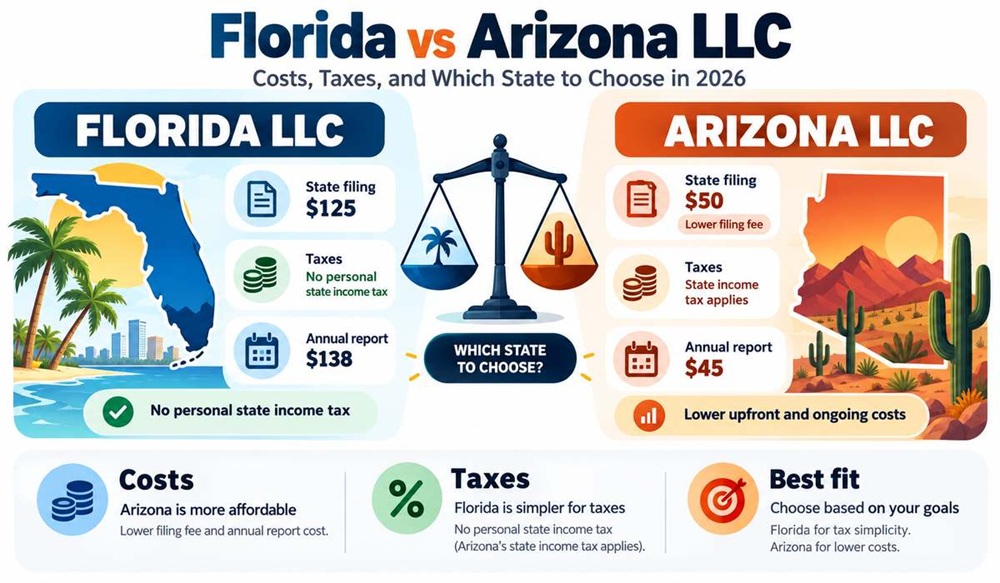 Florida vs Arizona LLC – What’s the Difference September 26, 2026 - Home » Advantages of an LLC in Virginia in 2025Florida vs Arizona LLC: Fees & Tax Benefits Arizona offers a cheap $50 filing and $0 annual reports, while Florida has zero personal income tax. Pick the best state for your LLC fees and tax benefits. Start Your LLC Today Trustpilot Register Your Business A Florida …
 What Is the California Secretary of State? September 25, 2026 - Home » Advantages of an LLC in Virginia in 2025What Is the California Secretary of State The California Secretary of State is a statewide elected official and the name of the government office that keeps many of California’s public business and election records. Start Your Business Trustpilot Register Your Business Business owners use the office …
 California vs Nevada LLC September 25, 2026 - Home » Advantages of an LLC in Virginia in 2025California vs Nevada LLC: Costs, Taxes, and Which State to Choose California vs Nevada LLC is a comparison of two states’ formation costs, annual fees, and tax rules. Nevada has no individual state income tax, while California charges an $800 annual LLC tax. If your business …